Building deformable-impact software
Spectral contact dynamics for drops impacting a bath
A millisecond decides the outcome
In printing, coating, sprays, and liquid handling, impact decides whether a liquid deposits, spreads, rebounds, or coalesces. That choice is made in milliseconds, while the bodies involved are changing shape.
The difficulty is that a deformable collision has no pre-existing contact area or pressure field. At first touch, pressure reshapes the interfaces, and their shapes alter the pressure. SpectralKM.jl asks how to solve that loop when both sides of the collision are liquid.
What each model removed
The 2022 rigid-sphere / elastic-membrane study made the first hidden variable visible: target deformation ((Agüero et al., 2022)). A liquid drop on a solid moved deformability into the impactor. A drop on a bath left neither side of the contact fixed ((Gabbard et al., 2025)). Each problem exposed a contact assumption that the previous one could afford to hide.
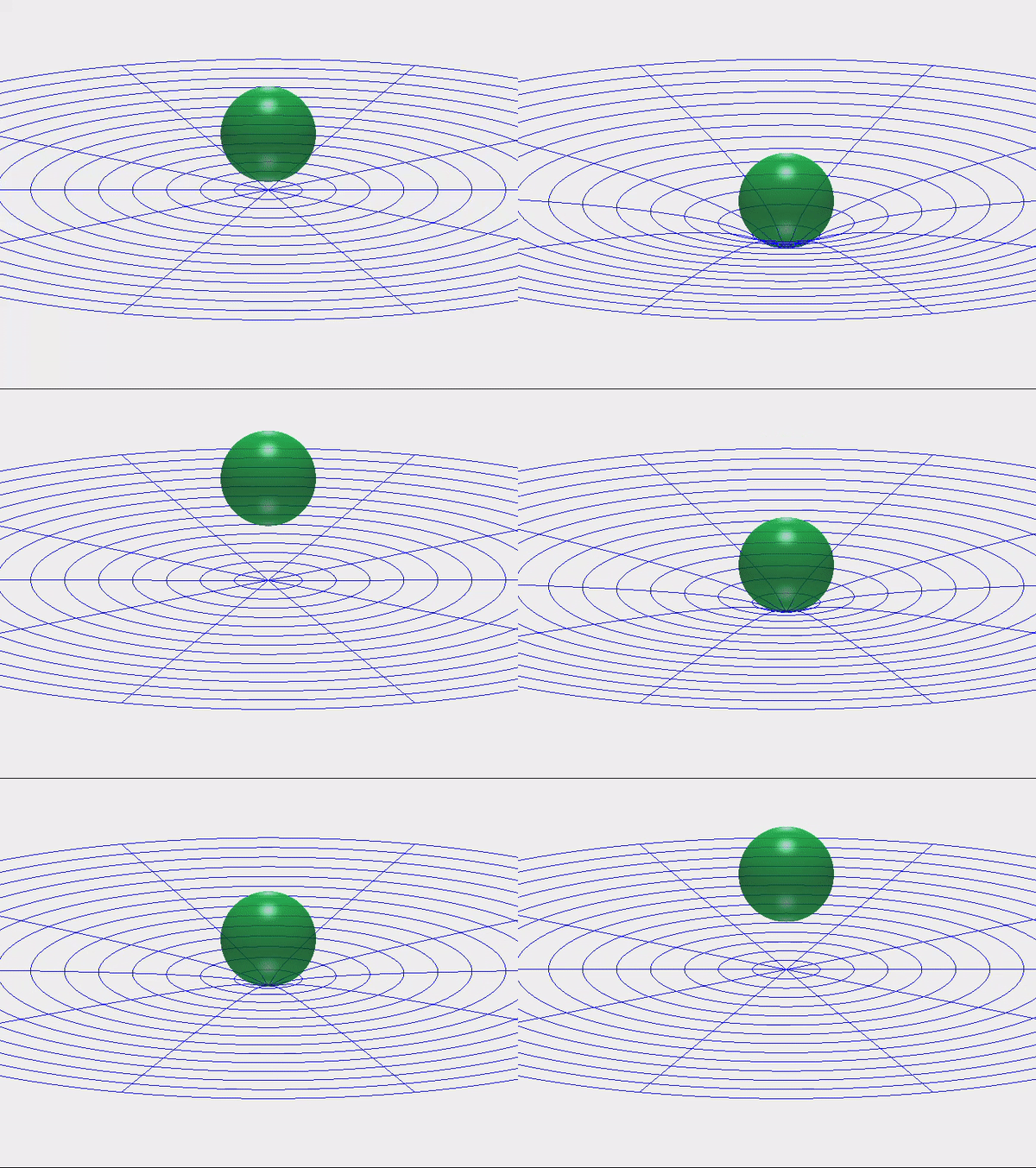
The solid-substrate branch then isolated non-Newtonian constitutive behaviour. Contact-dynamics work made pressure and contact extent explicit unknowns. That progression leads to the question the current model is built to answer: which part of a rebound is fluid dynamics, and which part comes from the contact prescription?
Spectral contact dynamics
SpectralKM.jl is the current Newtonian, non-coalescing drop–bath formulation. It represents the bath with Fourier–Bessel modes, the drop with Legendre modes, and contact pressure with shifted-Legendre modes. A feasibility-filtered outer search selects the contact patch.
It removes three choices that can otherwise decide a rebound prediction: a prescribed pressure profile, a mesh-level contact search, and a fixed liquid interface. The bath, drop, pressure supported on the patch, and contact extent are solved together. The result is a contact model whose physical assumptions can be inspected rather than buried in a solver switch.
The pressure inset is a diagnostic, not a polished field to over-interpret. It shows what the model solves at contact without pretending that a pointwise trace is the final answer.
Controlled rheology on a solid
DropRebound.jl keeps the substrate solid so it can isolate how constitutive behaviour changes rebound. SpectralKM.jl carries the contact problem to two moving liquid interfaces. The videos are separate numerical cases, not a benchmark.
Open source as research infrastructure
Contact models earn trust when their derivations, tests, diagnostics, and figures can be inspected together. The repositories keep package code, validation records, parameter sweeps, and rendering scripts beside the model, so a reader can reproduce a result or challenge an assumption without reconstructing the workflow from a paper.