Spin transport by measurement and inference
From LLG-based FMR fits to iSHE deconvolution and materials selection
Quantifying spin transport in thin films
A thin native oxide on permalloy (Py) inflates FMR linewidths and biases the Gilbert damping parameter α upward. The effect is invisible unless linewidth slopes are tracked across many frequencies and surface chemistry is cross-checked by XPS. Extracting the spin Hall angle of the adjacent heavy-metal layer via the inverse spin Hall effect (iSHE) is further complicated by anisotropic magnetoresistance (AMR) of the ferromagnet. AMR generates a voltage at the same resonance condition, and geometry alone cannot separate it from the iSHE signal.
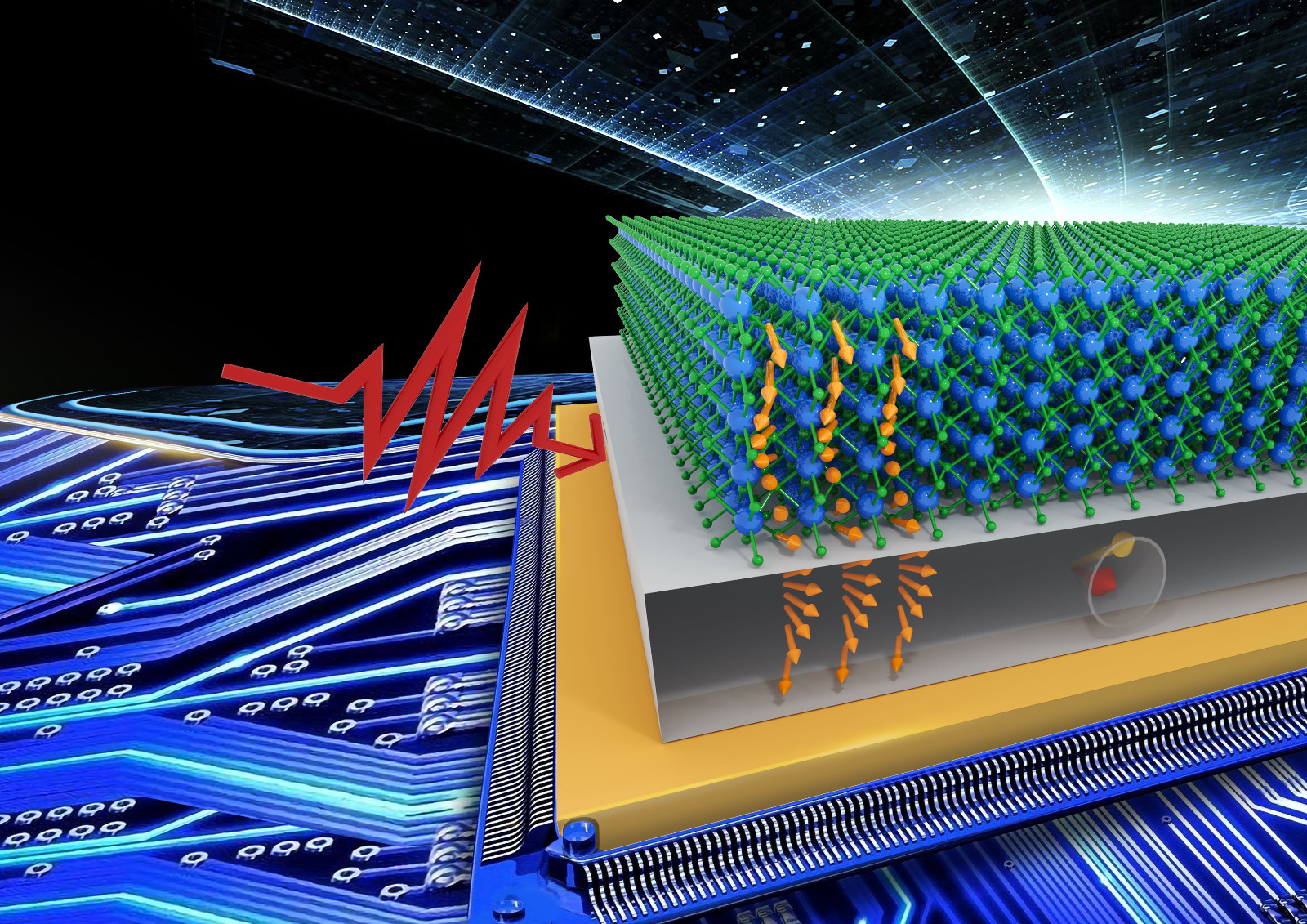
We measured four bilayer systems (Py/Pt, Py/W, Py/Cu, Py/Ti) and later YIG/Pt and YIG/W. For α, lock-in detection with field modulation extracted derivative-Lorentzian line shapes, and XPS-guided capping-layer selection kept the oxide contribution identifiable. For iSHE, Py/Ti served as the AMR reference: titanium has negligible spin–orbit coupling, so the voltage in that stack is a clean baseline. Subtracting it from Py/Pt and Py/W isolates the symmetric iSHE component. Switching to YIG (an insulating ferromagnet with no charge current in the magnetic layer) removed the leakage entirely, leaving purely Lorentzian iSHE line shapes.
Platinum’s spin-orbit coupling was the strongest by both measures simultaneously: largest damping enhancement and largest iSHE amplitude, a consistency that points to a real material effect rather than artefact. Tungsten was clearly second; copper and titanium were effectively zero, consistent with their weak spin–orbit coupling. The sign reversal between YIG/Pt and YIG/W agreed with the sign predicted for the spin Hall angle in theory. To keep the FMR rig running through overnight sweeps, we added a low-cost IoT monitor (ESP8266 + Hall flow sensor) with automated email alerts; it caught at least two coolant interruptions before they could spoil measurements.
Methods and data: Full report (PDF)