a3dasm: scientific loops for agentic engineering
An open, evidence-guided workflow for agents solving data-driven engineering problems
From an agent graph to a scientific loop
a3dasm turns a graph of agents into an open research loop. The agents can follow the evidence, change strategy, and decide which data to produce next. The loop is guided by the scientific method: state a mechanism, choose an experiment that can test it, retain the evidence, and let criticism change the claim.
Each study starts with a data-driven engineering problem and a runnable physical oracle. The workflow records hypotheses, simulation budgets, diagnostics, critical review, and replication scripts alongside the result. That makes an agent’s scientific decisions inspectable and gives the next run the evidence needed to improve on the last one.
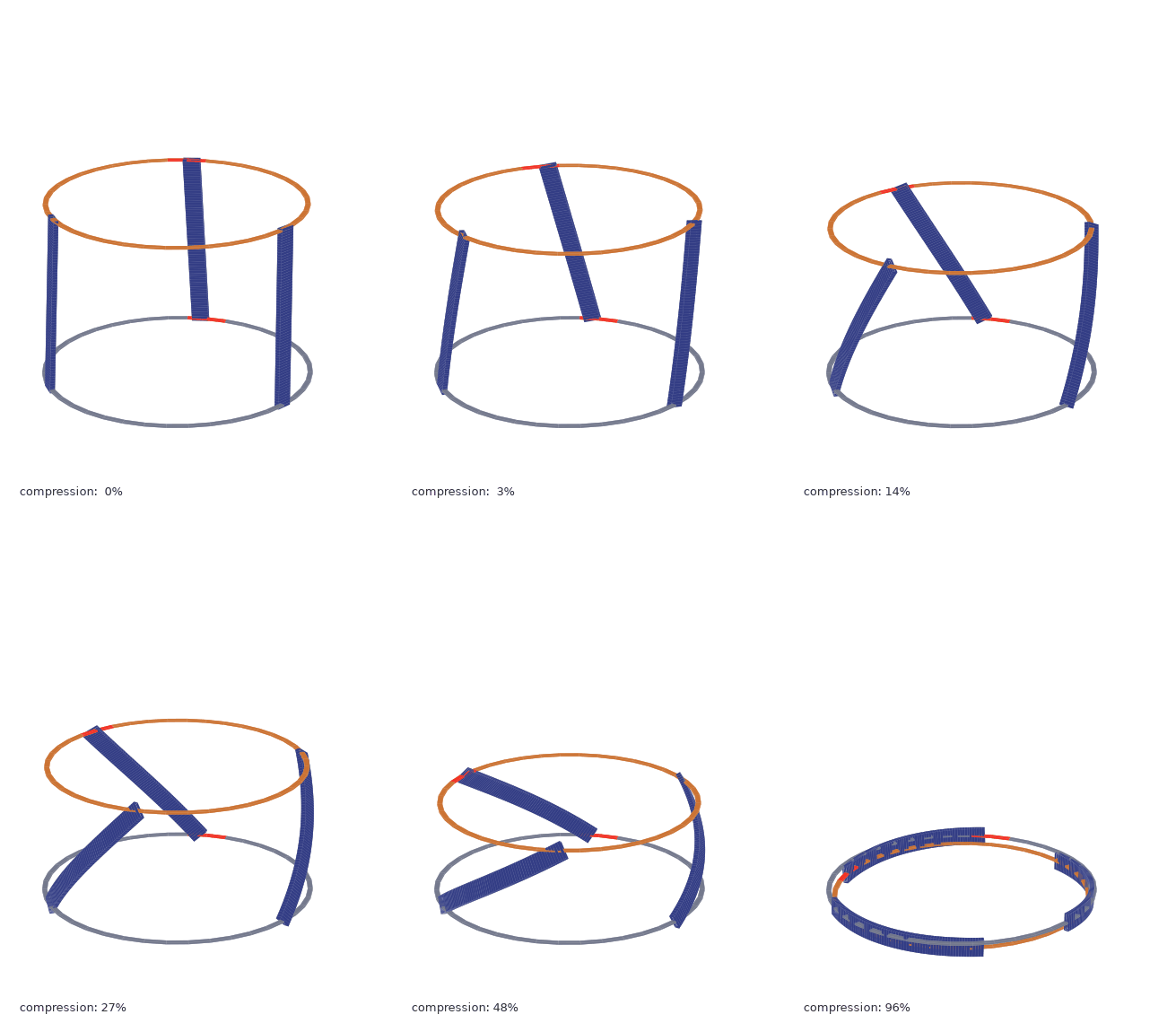
A rocking-mast metamaterial coiling under axial compression in the supercompressible-material study.
One case study, more than a fivefold advance
The supercompressible-material study asks agents to design a printable structure that coils under compression while carrying load. The workflow found a design that improves the state-of-the-art supercompressible reference by more than fivefold. It did so by turning an expensive finite-element oracle into a sequence of hypotheses, evaluations, and design decisions.
A testbed for data-driven engineering
The same loop can work across engineering scales and disciplines. Current studies include rocking-bag bioreactors, where motion and geometry must improve oxygen transfer without damaging cells; interfacial locomotion, where a floating body and its wave field must be designed together; inverse material identification from multiaxial stress–strain data; and supercompressible metamaterials.
Each study has an executable oracle, a limited evaluation budget, competing objectives or constraints, and a scientific claim that can be tested.
Research that compounds
Every run leaves a usable research record: the hypothesis, the data it generated, the simulation ledger, the critic’s verdict, and the script needed to reproduce the result. Failed directions remain part of that record. The result is cumulative engineering work that another researcher can inspect, replay, and extend.