Enabling interfacial locomotion
Wave-driven propulsion by a flexible raft
A vibration can choose a direction
A compact raft has no propeller, no fin, and no steady push. Yet move its vibrating motor away from the centre and the waves it radiates no longer leave equally in both directions. The wake becomes asymmetric; that asymmetric momentum flux gives the raft a direction of travel. The surprising part is that a zero-mean vibration can produce a nonzero mean thrust. It does so not by hiding a stroke cycle, but by changing how a deformable body launches waves into the surface.
That is a useful problem whenever actuation and structure are inseparable: a mechanism can look symmetric in a CAD model while its dynamics select a direction. The question is not simply whether the raft bends, or where the motor sits. It is how those choices reshape the waves that carry momentum away.
Published SurferBot demonstration. A physical demonstration of the mechanism; it is not numerical output from this repository.
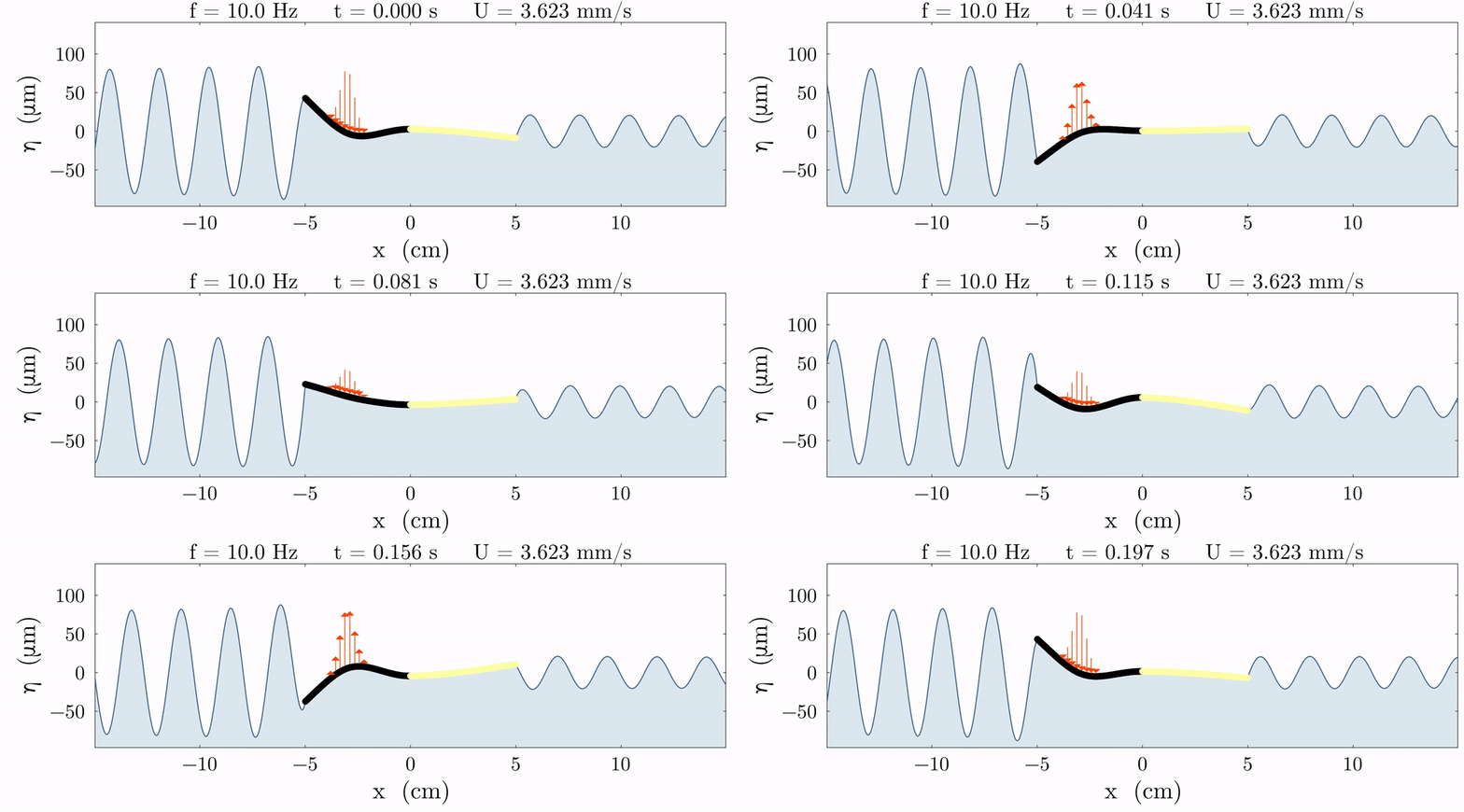
The calculation has to keep the coupling intact. The coupled beam–free-surface model resolves deformation, the outgoing wave field, and mean thrust in one system. Motor placement changes which bending modes are excited; flexural rigidity changes how those modes feed the waves. The resulting thrust is not monotonic in either variable. A static deformation or motor placement alone cannot tell us which way the raft will go.
I created the reproducible Julia analysis workflow behind that calculation: parameter sweeps, modal reduction, MATLAB parity tests, and figure generation from the same data. I also made the symmetry check explicit. In the reflection-symmetric pure-gravity benchmark, centred forcing must yield zero net thrust; if it does not, the discretization has manufactured propulsion. That invariant is not carried over to cases with capillary edge terms, where the exact reflection symmetry is physically broken.
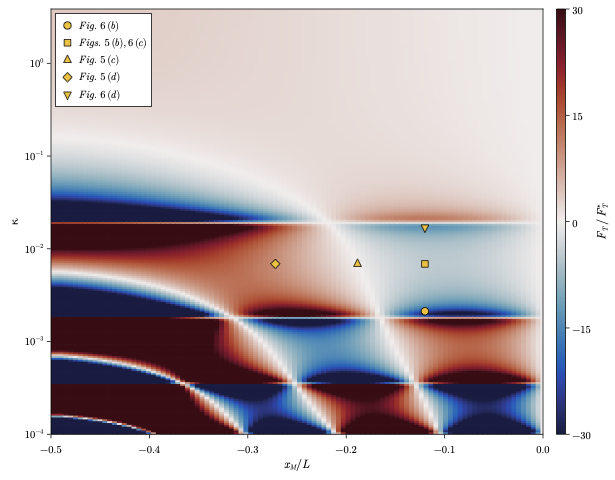
The map makes the design consequence visible: small shifts in motor placement can reverse the direction of travel, and the same actuator can behave differently as the raft stiffens or softens. It is a compact testbed for a broader R&D habit: treating the body, the forcing, and the surrounding medium as one dynamical design problem rather than three independent knobs.