Multi-fidelity design for rocking bioreactors
Coupled oxygen-transfer and shear design with multi-fidelity CFD
A rocking bioreactor looks simple: move a bag back and forth and the culture mixes. The useful engineering question is harder. The same rocking motion that renews the gas–liquid interface and improves oxygen transfer also sets the mechanical environment experienced by the culture. More agitation is therefore not a complete answer. A design must balance oxygen availability against shear, while accounting for fill level and rocking frequency before it is expensive to manufacture or test.
The model resolves that moving interface rather than replacing it with a well-mixed approximation. It uses Basilisk volume-of-fluid hydrodynamics, coupled to dissolved-oxygen transport through Henry’s law. From each simulated condition, the workflow extracts the process quantities that make the trade-off concrete: volumetric mass-transfer coefficient kLa, mixing time, and shear stress. Those outputs turn a vague request (“mix it better”) into an inspectable design decision: which fill level and rocking frequency provide adequate transfer without simply pushing every local stress measure upward?
Full CFD can answer that question, but is too costly to sweep the entire operating space. The project therefore pairs inexpensive low-fidelity screening with selected high-fidelity calculations. A KRR-LR-GPR multi-fidelity surrogate carries information between the two, while Expected Improvement selects the next condition to evaluate. The point is not to make the simulator disappear behind a black box; it is to spend high-fidelity runs where they can change the design choice, then use the cheaper model to map the rest of the space. That makes a wider set of fill levels and rocking schedules practical to compare.
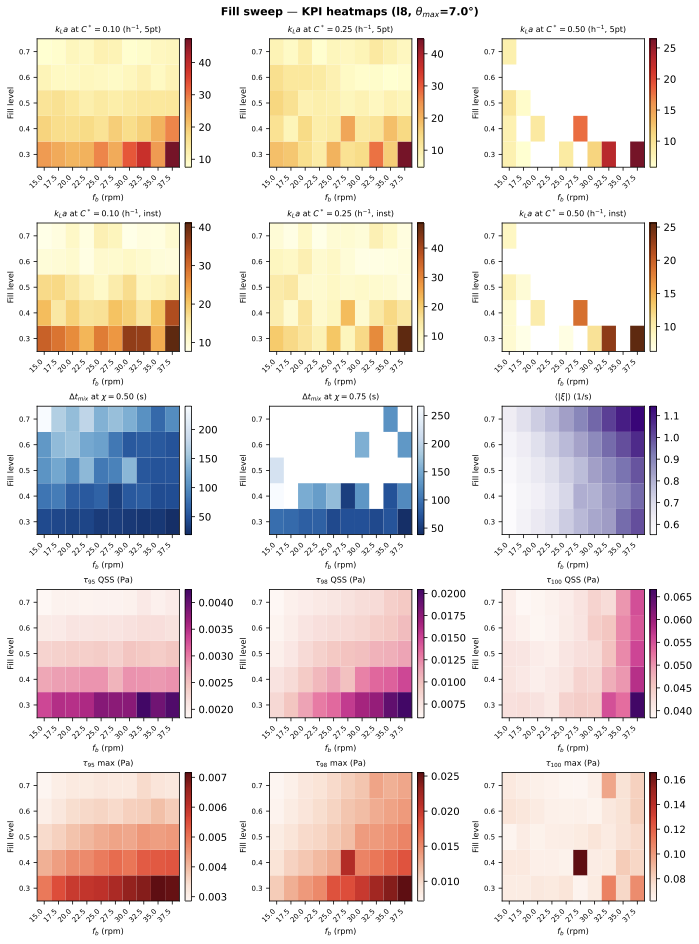
My contribution was the project’s decision and reproducibility layer around the solver: an end-to-end multi-fidelity Bayesian-optimization testbed, parameter-validation fixes, CI-deployed documentation, tutorials and figure pipeline, and validation and experiment records. That work makes a result traceable from a candidate condition through the simulation and surrogate workflow to the plotted evidence, without claiming sole authorship of the CFD method or the published study.
The underlying study is published in International Journal of Multiphase Flow. The project documentation and open repository include the model, case studies, and reproducible workflow.